A compliant Queensland bathroom renovation needs four things: a contractor holding a current QBCC licence for the class of work, Queensland Home Warranty Scheme insurance paid by that contractor on most residential building work valued over $3,300 including materials, labour and GST, waterproofing installed by an appropriately licensed person to AS 3740:2021, and written certification of the waterproofing, which on approval-assessable work takes the form of a Form 43 aspect certificate. Plumbing work must be done by a licensed plumber, and some of it is notifiable to the regulator. You can verify most of this yourself, for free, before you sign anything.
Key takeaways
- Search the contractor’s QBCC licence number on the QBCC public licence search before you pay a deposit, and check the licence class actually covers the work.
- Home warranty insurance is the contractor’s job to arrange and build into the price on work over $3,300, not a line item they add on top.
- Only an appropriately licensed person may waterproof an internal wet area, and the membrane must comply with AS 3740:2021.
- Ask for the waterproofing certificate in writing at handover. No certificate means no evidence the membrane was ever compliant.
- A like-for-like bathroom refit usually needs no building approval, but the plumbing and waterproofing rules still apply in full.

How do you check a bathroom renovator’s QBCC licence before you sign?
Take the licence number from their quote, website or vehicle, and search it on the QBCC’s public licence search. The search is free and returns the licence holder’s name, the licence classes they hold, the expiry date, and any disciplinary or defect history recorded against them.
Three things trip homeowners up here. First, the name on the licence should match the entity name on your contract. A quote issued by a trading name or a different company number to the licensed entity is worth questioning before money moves. Second, licence class matters more than the number existing: a licence permits specific classes of work, so a builder licensed for the structural side of a renovation is not automatically the person permitted to lay your waterproofing membrane or connect your plumbing. Third, licences expire. A number printed on a website two years ago proves nothing about today.
For reference, Eternity Bathrooms holds QBCC licence 15360519, and we expect clients to look it up. Any renovator who bristles at being asked for a licence number has told you something useful.

When does the Queensland Home Warranty Scheme apply, and who pays?
The scheme applies to most residential building work valued at more than $3,300, counting materials, labour and GST together. That threshold catches essentially every full bathroom renovation and plenty of partial ones.
The premium is paid by the licensed contractor and must be built into the contract price. It is not a surcharge to be billed to you separately as an extra. If a quote lists home warranty insurance as an additional line the homeowner pays on top, that is a conversation to have before signing.
Owner-builder work and work under the threshold are exempt. That exemption is why some very cheap quotes exist: an unlicensed operator working under the radar carries no insurance, so if the job is abandoned half-finished or the shower leaks into the hallway in three years, there is no scheme sitting behind it. The cover exists precisely for non-completion and defective work, which are the two failures homeowners least expect and can least afford.
Practical check: once the contract is signed and the premium paid, you should be able to confirm the policy exists rather than take it on trust. Ask your contractor for the notification and keep it with the contract.
| What you should hold | Who provides it | When |
|---|---|---|
| Written contract with a defined scope | Your contractor | Before any work starts |
| QBCC licence number you have independently searched | You verify it | Before deposit |
| Home warranty insurance notification (work over $3,300) | Contractor arranges and pays | After contract signing |
| Waterproofing certificate, Form 43 aspect certificate | Licensed waterproofer, via your builder | At or before handover |
| Plumbing compliance documentation where required | Licensed plumber | At completion of plumbing work |
| Warranty terms in writing | Your contractor | At handover |
Who is legally allowed to waterproof a bathroom in Queensland?
Waterproofing of internal wet areas must be carried out by an appropriately licensed person. It is not general labouring work, and it is not a task for whoever is on site that morning with a spare afternoon.
The governing standard is AS 3740:2021, referenced by the National Construction Code, and it covers shower floors and walls, bathroom floors, the area behind a bath, wall and floor junctions, and every plumbing penetration through the membrane. NCC 2022 tightened several requirements, including full waterproofing of shower walls and floor waste gradients set between a minimum of 1:80 and a maximum of 1:50.
That fall range is worth understanding as a homeowner, because it is where a lot of arguments start. Too flat and water sits on the floor and creeps toward the door. Too steep and tiles look wrong, large-format tiles will not sit flat, and a shower screen will not seal properly against a sloping base. Getting the screed inside that window is a skilled job, and it is one of the reasons a walk-in shower with a channel drain needs the fall planned before the screed goes down rather than corrected afterwards. If you want the technical detail on how the membrane itself is built up, our guide to long-lasting bathroom waterproofing and the walk-in shower design and drainage guide cover it. This page is about who is permitted to do it and what proves they did.
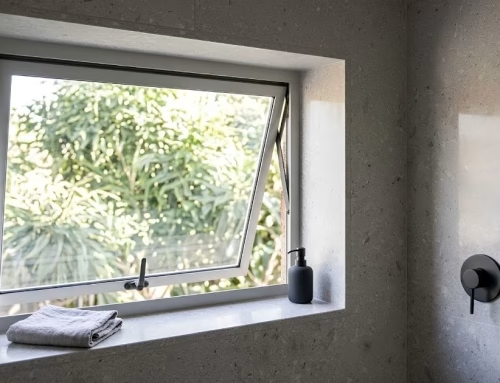
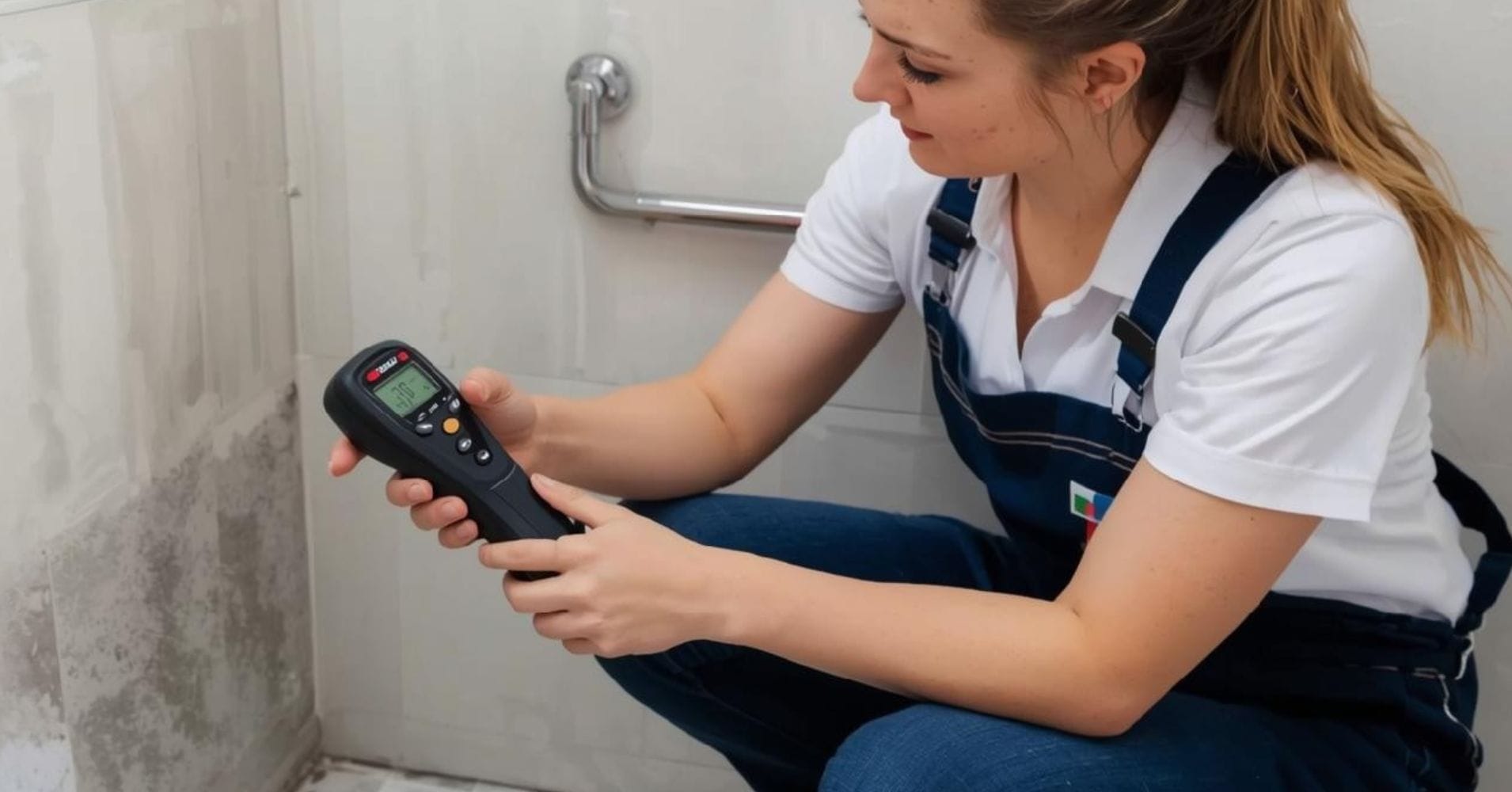
Brisbane makes the standard less academic than it sounds. A south-side bathroom with one small louvre window, in a summer where humidity sits high for weeks and a storm dumps rain through an afternoon, dries slowly. A membrane defect that a drier climate might tolerate for years shows up here as swollen skirting, dark grout at the base of the shower wall, or the smell of damp in a linen cupboard that shares a wall with the shower. Those are the early signs of waterproofing failure worth learning to spot.
What is a Form 43 and why does it matter years later?
In Queensland, the Form 43 aspect certificate is the document a QBCC licensee completes to record that an aspect of building work, waterproofing included, complies with the building development approval that work was carried out under. It names the licensed person responsible for that aspect of the work, and only the licensee who actually did the work can sign it.
Its value is almost entirely in the future. On the day of handover, the bathroom looks finished either way. The certificate matters when you sell the house and a buyer’s building inspector asks what was done, when an insurer asks whether wet-area work was carried out to standard after a water damage claim, or when a leak appears in year four and the question becomes who is accountable. Without it, you have a tiled room and a story.
One point is worth understanding, because a lot of online advice gets it wrong. A Form 43 is issued where the waterproofing forms part of work carried out under a building development approval. Plenty of like-for-like bathroom renovations proceed without a building approval, and in those cases no Form 43 is generated. On its own that is not a warning sign.
What you should insist on either way, in writing, is the membrane system used, the areas it was applied to, who applied it and their licence details, and the product warranty. Keep whichever document you receive with your contract, and store a scan somewhere that survives a computer replacement. A builder who cannot tell you in writing what was applied and by whom is a different problem entirely.
Does a bathroom renovation need building approval in Queensland?
Usually not, if you are replacing what is already there. A like-for-like refit inside an existing bathroom, new tiles, new fixtures in the same positions, a new vanity, a shower rebuilt in the same footprint, generally proceeds without a building approval from a private certifier. The waterproofing and plumbing rules still apply in full regardless.
Approval enters the picture when the work goes beyond a refit. Common triggers include removing or altering a load-bearing wall, changing the size or position of a window or external opening, extending the bathroom footprint into another room or outward, work on a house with a heritage or character overlay, and structural changes to floor framing. Some plumbing work is notifiable, meaning your licensed plumber must lodge it with the regulator; relocating a toilet, adding a new fixture, or altering drainage is a different matter from swapping a tap onto existing pipework.
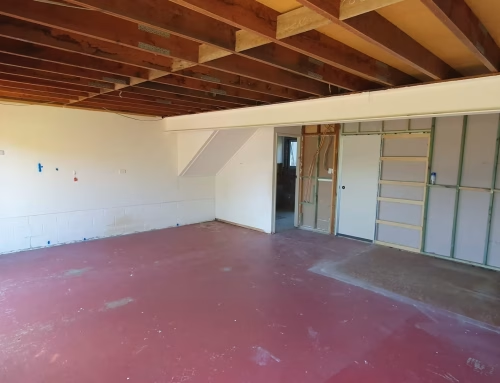
The honest answer for most homeowners: if you are moving walls, moving drainage, or touching structure, ask early. Councils across Brisbane, Logan and Redland differ in how their local planning overlays apply, and a character or demolition control overlay on a pre-1947 house changes what you can do to external walls. This is one of the reasons an older Brisbane home needs its compliance questions settled before demolition rather than during it, along with testing for asbestos in wall and floor linings, which is a competent-person job and, where removal is required, licensed work.

What should be in the contract before you pay a deposit?
A defined scope, in writing, with the compliance points named. Vague quotes are where disputes are born, because a single line reading “renovate bathroom” leaves every inclusion arguable later.
Look for these specifics before signing:
- The licensed entity’s legal name and QBCC licence number, matching what you searched.
- A scope that lists what is included and, just as importantly, what is excluded.
- Who is responsible for waterproofing and confirmation that a certificate will be issued.
- How variations are priced and approved, in writing, before the extra work happens.
- Payment stages tied to progress, with a deposit within legal limits rather than a large upfront sum.
- The warranty terms and what they cover.
Fixed-scope quoting exists to close those gaps. Our quotes define the scope and the inclusions up front so the price is not a moving target once the walls are open, and the common renovation mistakes we see most often start with a quote that never said what it covered.
How does compliance show up during the actual build?
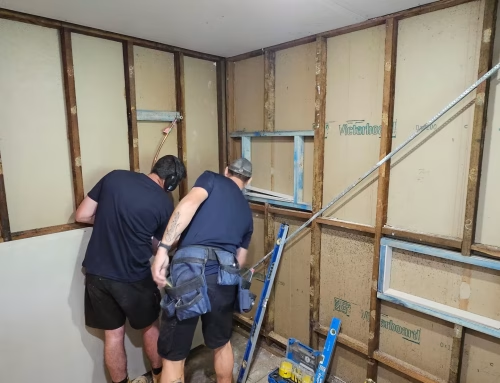
At specific, visible checkpoints, not as paperwork produced at the end. Rough-in plumbing and electrical happen before wall sheeting, so anything wrong there is expensive once tiles are on. The screed and its fall are set before the membrane. The membrane goes on and must cure before anything is laid over it, with the cure time driven by the product data sheet and site conditions rather than the tiler’s schedule. Then tiling, then fit-off.
The sequence is the compliance. A builder who tiles over an uncured membrane, or who cannot tell you who applied it, has skipped a step you cannot see afterwards. Our week-by-week guide to the build walks through what each stage should look like from the homeowner’s side of the door.
Running licensed trades in-house is how we keep those checkpoints tight: carpenter, plumber, electrician, waterproofer, tiler, glazier, plasterer and painter, with more than 50 years of combined experience across the team and 20 years in the industry for owner Shannon Jones. It means the waterproofer is not a subcontractor squeezed between two other jobs on a day the screed is not ready.
Frequently asked questions
Can I do my own bathroom waterproofing in Queensland?
Waterproofing of internal wet areas must be carried out by an appropriately licensed person, so it is not a DIY task in a standard homeowner renovation. Beyond the legal position, a self-applied membrane will not come with a Form 43 aspect certificate, which is the document a buyer, insurer or future tradesperson will ask for.
What happens if my builder does not give me a waterproofing certificate?
Ask for it directly and in writing first, because it is sometimes simply sitting in a job file. If it does not exist, that indicates the aspect was never certified, and the QBCC is the body that handles licensing and defective work complaints in Queensland.
Is home warranty insurance something I pay separately?
No. On work over the $3,300 threshold, the premium is paid by the licensed contractor and must be included in the contract price rather than billed to you as an added extra.
Does replacing a shower screen or a vanity need approval?
A straight replacement in the same position generally does not need building approval, but plumbing connections remain licensed work and any disturbance to the membrane around a penetration needs to be made good properly. Swapping a vanity often exposes older pipework, which is when a small job turns into a larger one.
How do I check a licence if I only have a business name?
The QBCC public licence search allows searching by name as well as by licence number. If the trading name returns nothing, ask the contractor for the exact licensed entity name and the licence number, and compare it against the name on the quote.
Talk to a licensed Brisbane southside renovator
If you want a bathroom quoted with the scope, the licensing and the certification spelled out before anything is demolished, get in touch. Eternity Bathrooms is family-run, holds QBCC licence 15360519, and works across Brisbane’s southside, Logan, Redlands, Beenleigh, Pimpama and the Gold Coast.
Call 0499 296 254 to arrange a fixed-scope quote, or send the details of your bathroom through the contact page. You can also read more about our bathroom renovations, waterproofing and plumbing work.